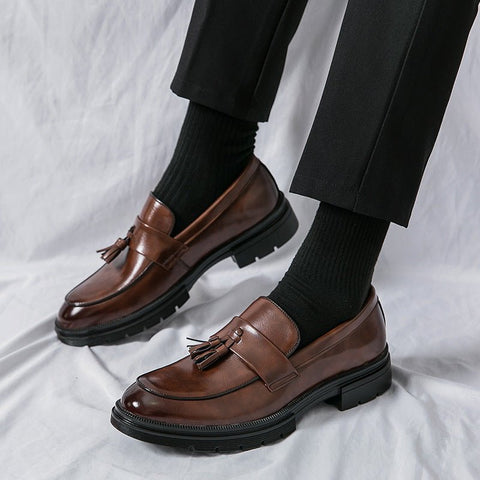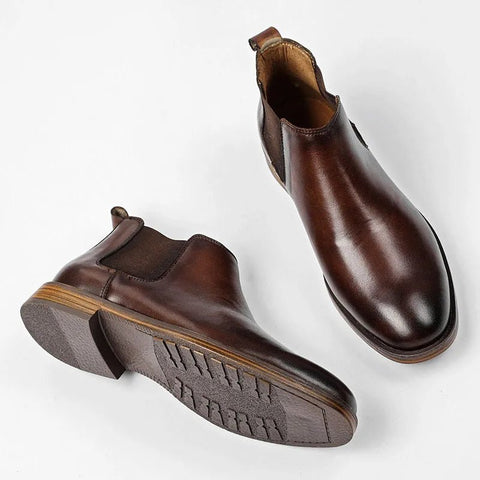
Boots are the shoe most men reach for first when the weather turns, and they are also the easiest place to start if you want a little more height. The reason is simple. A boot covers the ankle, so the point where the shoe meets your trouser is hidden, and the eye reads one continuous line from hem to floor. Nothing about the look asks for explanation.
This guide covers which boot styles do that best, how to wear them through autumn, and what to think about before you buy your first pair.
Why boots are the easiest way to add height
Every shoe that adds height has to put the lift somewhere. In a low-cut shoe, the opening sits below the ankle bone and the whole silhouette is visible at a glance. A boot changes that. The shaft rises past the ankle, your trouser or jean breaks over it, and the transition disappears into the outfit.
Autumn helps too. Boots are simply what men wear from September onward, so a boot never reads as a deliberate choice the way a taller casual shoe sometimes can in July. You are wearing the season, not making a statement.
The leg line does half the work
Height is partly a matter of proportion, not just measurement. A long, uninterrupted vertical line reads taller than the same person in a broken one. Boots create that line naturally, especially with a trouser or jean cut close enough to sit over the shaft rather than pool on top of it. Keep the tone of your trouser and boot in the same family and the effect is stronger still.
How much height do boots add
It depends on the style. Every pair is different, and each product page lists its own figure, so the honest answer is to check the boot you are actually considering rather than assume a number across the range.
What is consistent is where the lift sits. It is built inside the shoe rather than under it, so there is no external platform and no thick slab at the heel. From the outside, the boot has the proportions of a boot.
Three boots worth knowing this fall
We carry three boots, and they do three different jobs. Here is how to choose between them.
Wellington, the Chelsea boot
The Wellington is the most versatile boot in the range. Clean lines, no laces, an elastic panel at the side, and a shaft that finishes just above the ankle. It carries a suit on a Monday and dark denim on a Saturday without changing character. If you want one boot to do everything this season, start here.
Style it with a slim or straight trouser that breaks lightly over the shaft. Avoid a wide leg that swallows the boot, since that flattens the line you are trying to build.
Ridgeway, the low-cut boot
The Ridgeway sits lower on the ankle, which makes it the smart casual option of the three. It works with chinos and an overshirt, and it moves between the office and the weekend without looking like it belongs to only one of them. The brown reads warmer and more relaxed than a black boot, which is what most men want in early autumn.
This is the boot to buy second, once you already own something darker and more formal.
Timberline, the lace-up
The Timberline is the most rugged of the three, a lace-up mid-calf boot with more visual weight and a taller shaft. That extra shaft height is useful, because it gives the boot more room to cover and a stronger vertical line. This is the weekend boot, at home with jeans, a knit and a jacket.
Because a lace-up carries more presence, keep the rest of the outfit calm. One statement piece per look is plenty.
Will anyone notice
How much anyone notices depends on the style you choose and how you wear it. The lift is inside the design rather than beneath it, so a boot looks like a boot from the outside. There is no visible platform and nothing that reads differently in passing.
The thing most likely to draw a comment is not the shoe. It is an abrupt switch. If you go from flat trainers on Friday to a taller boot on Monday with no seasonal reason, people notice the change more than the object. Autumn removes that problem entirely, which is another argument for starting now. Everyone changes their footwear in September.
Wearing boots through a full day
Our boots are designed for all day wear, with cushioning built into the construction. Even so, treat a new pair the way you would treat any new boot. Wear them for a few hours at home first, then a half day, then a full one. Your foot is adjusting to a new position as well as a new shoe, and giving it a week of short wears makes the transition easier than doing it in one go on a travel day.
If you want to adjust the feel of a pair you already own, the Modern Insole is sold separately and works with some styles. Compatibility depends on the shoe, so check with our team before buying one for a specific pair.
How to style height-increasing boots
With denim
Dark, straight or slim denim is the strongest partner for a boot. The darker the wash, the cleaner the line into the shoe. Let the hem break lightly on the shaft rather than stacking on top of it. A single cuff works if the length is not exact.
With chinos
Chinos in stone, olive or navy sit naturally with the Ridgeway and the Wellington. Keep the trouser tapered enough to hold its shape over the boot. This is the everyday autumn uniform for most men, and it needs nothing else to work.
With tailoring
A Wellington under a suit is a considered choice rather than a compromise. Keep the boot dark, keep the tone in the same family as your belt, and let the trouser fall to a light break. The result is sharper than a heavy lace-up and warmer than a low dress shoe in October.
Finish the look
The boot is the anchor, but the details around it are what make an outfit read as considered rather than assembled. Four things do most of that work.
A belt matched to the tone of your boot is the fastest signal that a look was put together on purpose. The Modern Belt has a clean laser-cut buckle that suits a smarter outfit, and The Classic Belt uses a traditional pin buckle that sits more naturally with denim and a lace-up boot.
Socks matter more with boots than with any other shoe, because the shaft keeps them in view every time you sit down. The Comfort Sock covers everyday autumn wear, and The Presidential Dress Sock is the one to reach for when the Wellington is going under tailoring.
Carry pieces should echo the same tone family as the boot and belt. The Modern Cardholder keeps a pocket flat, The Modern Wallet is the more traditional option, and The Modern Briefcase finishes an office look built on a Chelsea boot.
Everything sits together in the accessories collection.
Choosing a tone
Tone matters more than most men expect, and it is the decision people get wrong most often on a first pair. The instinct is to buy something interesting. The better move is to buy something that disappears into your existing wardrobe, because a boot you can wear four days a week earns its place faster than one you save for occasions.
Black is the most formal and the least flexible. It belongs with tailoring and dark denim, and it looks deliberate with anything lighter. Dark brown is the workhorse. It handles almost everything a black boot does, and it also sits happily with grey, navy, olive and stone. Medium brown and tan are the most relaxed of the group, strong with chinos and light denim, weaker with a suit.
If you are buying one pair, dark brown gives you the most days of wear. If you are buying two, add black rather than a second brown, because the two tones cover opposite ends of your week instead of overlapping in the middle.
Wearing boots from September to November
Autumn is really three wardrobes wearing the same shoes. Early September is still warm, and the Ridgeway with chinos and a light overshirt is enough. By October the weight of the outfit changes, knitwear appears, and the Wellington or the Timberline starts to look right with heavier denim. By November you are layering properly, and the boot is doing structural work at the bottom of a look that has a lot going on above it.
The practical takeaway is that a boot bought in early September gets three months of hard wear before winter, which is the best value any shoe in your rotation will deliver. It is also why the first weeks of the month are the right time to buy rather than the last. A pair that arrives in mid September is broken in and comfortable by the time the weather actually demands it.
If autumn travel is in your plans, a single dark boot also solves most of a packing problem. Our guide to packing shoes for travel covers how to build a trip around one or two pairs rather than four.
Getting the fit right
Fit matters more with a boot than with almost anything else, because the shaft holds your foot in place and the wrong size shows itself quickly. Check the sizing guide before ordering, and if you are between sizes or you wear an insert, write to our team and we will help you decide. Exchanges are available within 7 days of delivery with no restocking fee, so a sizing question is a solvable problem rather than a risk.
Common questions
Do boots make you look taller than other shoes
Boots hide the transition between shoe and trouser, which produces a longer, cleaner leg line than a low-cut shoe. That proportion is part of why they read the way they do.
Which boot style is the most discreet
The Wellington in a dark tone is the quietest of the three. It has the least visual weight, no laces to draw the eye, and a shaft that sits neatly under a trouser.
Can I wear height-increasing boots to the office
Yes, if the style suits your dress code. The Wellington works in most business casual settings, and the Ridgeway suits more relaxed ones. Our guide to wearing height-increasing shoes at work covers dress codes in detail.
How should I break in a new pair
Short wears first, building to a full day over a week. Wear the socks you plan to wear with them from the start so the fit you are testing is the fit you will get.
What should I look for in my first pair
Pick the style that matches most of your week rather than the one that looks best in isolation. For most men that is the Wellington in a dark tone. Our guide to choosing height-increasing shoes walks through the decision in full.
Do I need to change how I dress to wear them
Not fundamentally. The adjustments that help most are ones that improve any outfit anyway, chiefly trouser length and keeping tones in the same family. Our styling guide covers the full set.
Should my first pair be boots or shoes
In September, boots. They suit the season, they cover the transition between shoe and trouser, and they will get more wear over the next three months than anything else you could buy. If your week is mostly formal, a dress style is the better first purchase, and boots become the second pair.
Where to start
If you are buying one pair for autumn, make it the Wellington in a dark tone. It covers the widest range of settings, it is the most discreet of the three, and it will still be the boot you reach for in March. Add the Ridgeway second for smart casual days, and the Timberline third if your weekends call for it.
Shop casual shoes and boots, or browse all styles to see the full range. Free economy shipping on orders over $50.